

What is Personal Fable?
‘Personal Fable’ is a kind of belief, a personality trait during adolescence. This term was coined by psychologist David Elkind in 1967, when he described it as a result of adolescent egocentrism, which emerges around the age of 11 to 14 and gradually fades through adolescence (Scienceinsights, 2026). At this stage, adolescents think that their thinking is exceptional and different from others. Therefore, parents, professionals and educators should know about the details of personal fable so that they can channelise these things in an effective manner to cross this critical developmental stage. Sometimes it is misunderstood as a disorder, but it’s a type of personality development through abstract thinking in adolescence, a small part of developmental psychology. Some consider this a belief of uniqueness through which one can explore their identity by comparing themselves with peers (Sus & Drew, 2023).
Why do personal fables develop during adolescence?
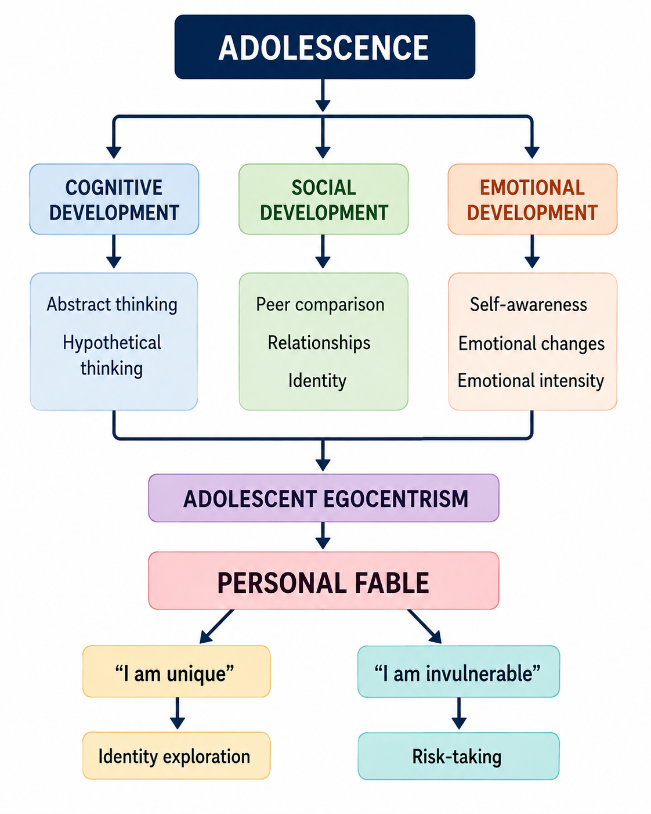
Adolescence is a transitional phase between childhood and adulthood. Erikson illustrated that at this stage, individuals learn social dynamics, compare themselves with others and become restless to find their identity. Piaget mentioned in his theory that during adolescence individuals can think beyond concrete thinking and develop their ability towards abstract thinking, which leads towards cognitive development, including egocentrism, hypothetical ability, decision-making ability, being able to judge, being able to control emotions, etc. From this theory, David Elkind (1967) extended the concept of personal fable, where people are more conscious about themselves, unable to separate their own thinking from others, involved in risk-taking behaviour without a single thought about the negative consequences of it, etc. Elkind (1967) described that the personal fable emerges during pre-adolescence and increases with age, whereas Albert et al. (2007) showed personal fable is positively correlated with risk-taking behaviour, although risk-taking behaviour is a reflection of one’s cognitive immaturity.
In a nutshell, we can say that during adolescence, the prefrontal cortex develops more, and adolescents become able to think more rationally and abstractly; rapid social and emotional changes also happen in this period. So, the adolescent period is a very crucial stage, and the development of personal fable occurs because of a variety of factors like cognitive factors, social factors (social comparison), contextual factors (including cultural differences), causes of different parenting styles, and social media, etc. (Rathore, n.d).
“Nobody understands me”: Why do most adolescents often say this?
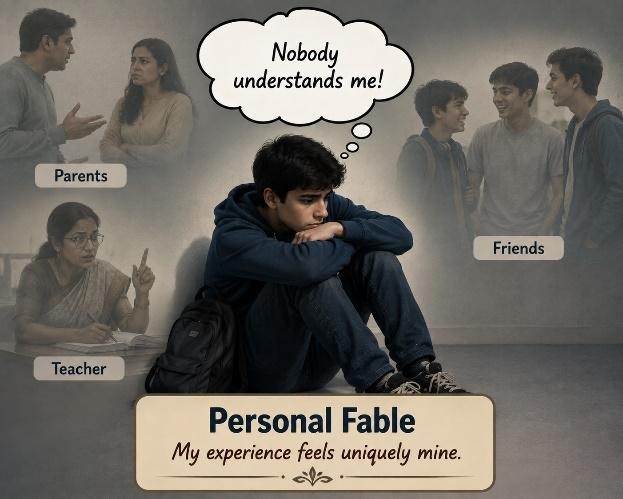
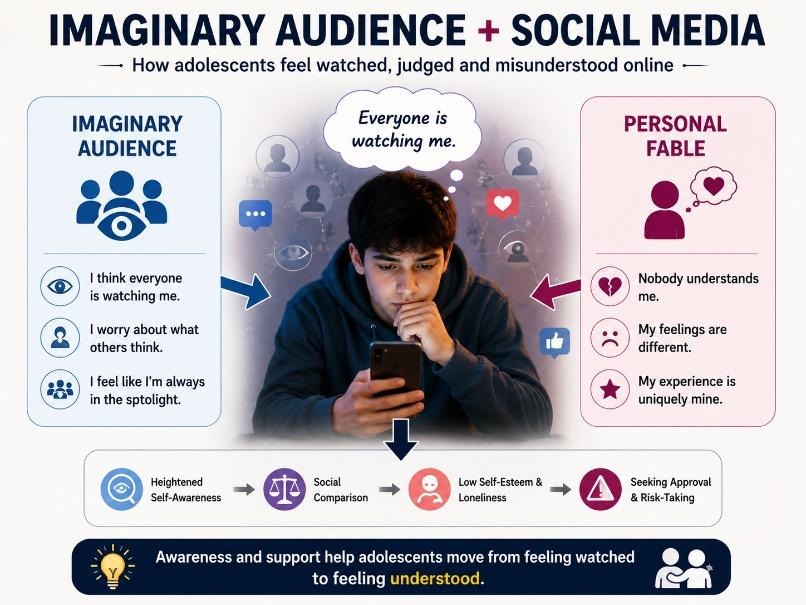
‘Nobody understands me’ is a very familiar statement; we often listen in our lives, mostly from adolescents, whose voices frequently echo this. Adults may find this statement to be coloured or exaggerated, but for adolescents this reflects their experience of developmental issues, psychological & emotional problems which may arise from unrealistic expectations, emotional invalidation, role confusion, being unable to find their identity, social comparison, communication barriers, fear of vulnerability, etc. (Mo, 2025). Some researches shows that the feeling of ‘nobody understand me’ does not indicate something wrong with that person, it is a common fleeting feeling which everybody can get from anywhere (like- from school, family, peer group, social gathering, close relationship etc.), mostly it reflects the gap between one’s inner awareness about self and what other people see or think about that person. The feeling of being misunderstood, ignored, unheard, etc. most frequently hurts one because these are connected with emotional safety and belongingness (Psyducate, 2026). Every adolescent goes through the process of personal fable, which plays a vital role in forming their self-perception and identity exploration. Elkind (1967) extended the concept of Piaget’s egocentrism and introduced two more concepts, viz. imaginary audience (that means somebody is judging or observing) and personal fable (belief of uniqueness about self ), where these two are responsible for adolescents’ diverse behaviour, thinking, confidence and invulnerability.
Personal Fable & Adolescents’ Emotions
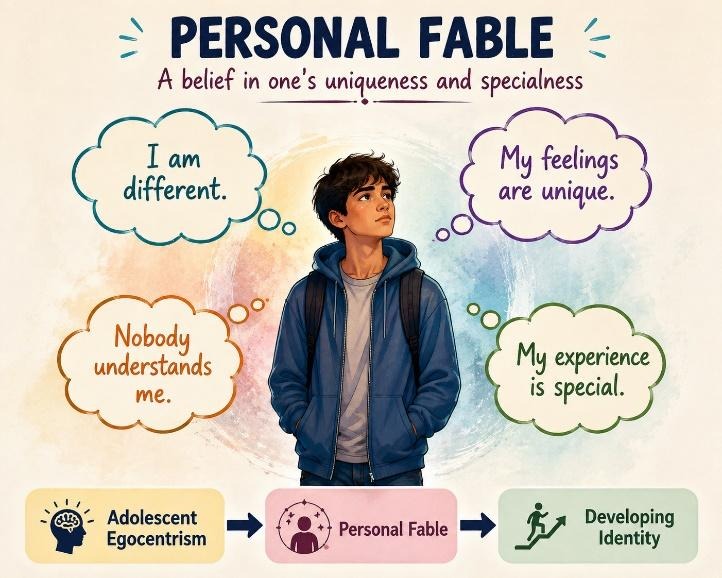
Many teens say, “Nobody understands what I’m feeling” – not just to get attention. They can be extremely emotionally charged. This can be caused by a sense of emotional uniqueness, facilitated by the personal fable.
This can be a two-way street. As one side of the coin, thinking “I’m different” can be a way for adolescents to discover themselves and slowly develop a sense of self. On the other hand, as “Nobody could possibly understand me” evolves into uniqueness, it can make young people feel isolated. Aalsma, Lapsley, and Flannery (2006) found that the personal-uniqueness dimension was associated with indicators of emotional maladjustment, including depression and suicidal ideation. So, when a teenager says, “You don’t understand me,” adults don’t always need to argue back. Sometimes the better response is to listen first. The feeling could be exaggerated, but the emotion is genuine.
Influences of social media on adolescents’ personal fable
Social media influences on adolescents’ perception regarding personal fable. The 21st century is the peak of digitalized era; everyone is connected through social media platforms where information or any kind of post reaches millions of audiences within a few seconds. Although social or digital media do not affect all adolescent in the same way, these media are an integrated part of their daily life. A study found that a large number of teenagers (between 13 and 17) use one to five social media platforms (viz. YouTube, Instagram, Facebook, etc.) several times a day, and that their use of social media determines their mental health and thought process (Mayo Clinic, 2025). These days, social media plays a significant role behind the emotion ‘nobody understands me’. In most cases, people only show off their lifestyle by posting attention-seeking content, pictures of their glamorous and fancy lifestyle, where they hide their emotional struggles and all. When people go through hard times and get exposure of such posts getting more depressed and anxious. Then their inner self immediately and continuously judges themselves, heightens their self-awareness and also starts to compare themselves with an imaginary audience, which leads them towards low self-esteem. This time they think like: why do only bad things happen to me? Nobody understands my way of thinking? etc. Adolescents who use social media more often strive for creating idealized image, and they will take the initiative of risky behaviour to achieve some approval without thinking about its consequences. As a result of this, adolescence impacts mental resilience.
What should teachers and parents do?
Being a teenager is very difficult because, at this stage, they go through the processes of hormonal changes, cognitive shifting, step into more abstract thinking, are unable to manage their emotional turmoil, and are concerned about identity formation, etc. They become more self-centred, very often fail to understand others’ perspectives, have heightened self-awareness and prioritize self. Daniel Lapsley interpreted the process of personal fable as psychological scaffolding that will support teenagers to boost their self-confidence and become independent (Neurolaunch, 2024). Still, most of the time, at this egocentric stage, at first adolescent needed parental support the most to navigate their life. Because parents can play the best role of a therapist by asking them what is happening with them. Without mocking them or attacking their identity, so that their children can open up and acknowledge their feelings before their parents. After that, parents should validate their emotions, expose the adolescent to natural outcomes, create a real-life setting with some boundaries where they can freely test their assumptions and also discuss how they learned from their faults so that the teenager can feel at ease. Teachers are also able to arrange vulnerability-free places for discussing teenagers’ issues and can organise group discussions where they are free to express themselves without the fear of being judged. Besides these, for a reality check adolescent can use journaling (where one writes all things comes in mind to find out the pattern of thinking), meditation and mindfulness (where one meditates to strengthen focus and pause before giving any reaction), role-playing (which helps to identify risk-taking behaviour), strategies, etc.
Conclusion
Personal fable is really a very important part of growing up, not only a stage of cognitive distortion. During adolescence, when one faces challenges, he/she is not necessarily immersed in depression, self-esteem, or self-doubt but can channel their life through the support of both teacher and parent. Personal fable and imaginary audience, both constructs, are the reasons behind the psychology of ‘nobody understands me’. The personal fable acts like a double-edged sword – on one side, this leads to emotional turmoil, self-doubt, poor decision-making ability, etc., but on the other side, this drives ambition, creativity and resilience. So, instead of eliminating personal fables, both teachers and parents can adopt a collaborative approach to balance their sense of uniqueness in real life, developing identity, emotional resilience and fostering their overall growth.
Declaration: Images are generated using Generative AI tools
References
Aalsma, M. C., Lapsley, D. K., & Flannery, D. J. (2006). Personal fables, narcissism, and adolescent adjustment. Psychology in the Schools, 43(4), 481–491. https://doi.org/10.1002/pits.20162
Abert, A., Elkind, D. & Ginsberg, S. (2007). The personal fable and risk taking in early adolescence. Journal of Youth and Adolescence, 36 (1), 71-76 https://doi.org/10.1007/s10964-006-9144-4
Elkind, D. (1967). Egocentrism in adolescence. Child Development, 38(4), 1025–1034. https://doi.org/10.2307/1127100
Enright, R. D., Lapsley, D. K., & Shukla, D. G. (1980). Adolescent egocentrism and self-consciousness. Journal of Youth and Adolescence, 9(2), 101–116. https://doi.org/10.1007/BF02087929
Galanaki, E. P. (2012). The imaginary audience and the personal fable: A test of Elkind’s theory of adolescent egocentrism. Psychology, 3(6), 457–466. https://doi.org/10.4236/psych.2012.36065
Mayo Clinic Staff. (2025, December 24). Teens and social media use: What’s the impact? Mayo Clinic. https://www.mayoclinic.org/healthy-lifestyle/tween-and-teen-health/in-depth/teens-and-social-media-use/art-20474437
Mo. (2025, September 17). Understand me? Find effortless answers. Psychologyly. https://psychologyly.com/understand-me-find-effortless-answers/
Neurolaunch. (2024, September 15). Personal fable psychology: Exploring adolescent egocentrism and its impact. https://neurolaunch.com/personal-fable-psychology/
Psyducate. (n.d.). Why do I feel like nobody understands me? 9 real reasons and what to do. https://www.psyducate.com/2026/03/why-do-i-feel-like-nobody-understands.html
Rathore, N. (n.d.). Unravelling the roots of personal fable in teens. PsyWellPath Glossary. https://glossary.psywellpath.com/causes-personal-fable-adolescents#causes-of-personal-fable-development-in-adolescents
ScienceInsights. (2026, April 29). What is the personal fable in psychology? https://scienceinsights.org/what-is-the-personal-fable-in-psychology/
Sus, V., & Drew, C. (2023, September 18). 10 personal fable examples. Helpful Professor. https://helpfulprofessor.com/personal-fable-examples/
 Dr. Roshni Mukherjee
 Sheikh The Wanderer