


“If I look at the mass I will never act. If I look at the one, I will.” —Mother Teresa
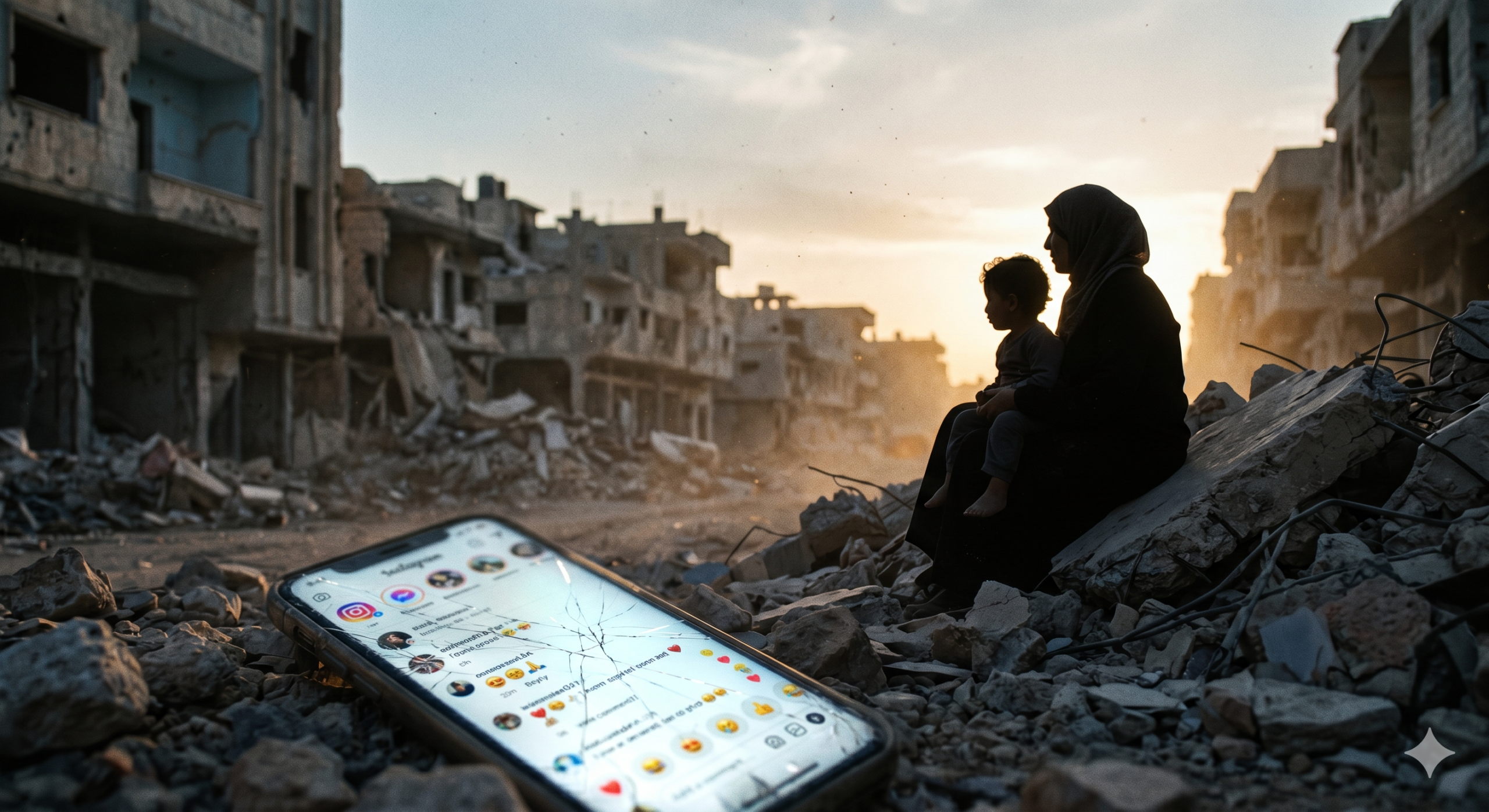
The sun sets over a war-torn city. A mother watches her child cry from hunger. A family stands at their doorstep watching floodwater rise. A family is fleeing a war zone. Twelve thousand miles away, someone double-taps & likes a post about it and keeps scrolling.
You probably already knew about the suffering.
And yet. Nothing changed.
That is the strange and uncomfortable truth about modern humanity: we know more about suffering than any generation before us, and we are acting less.
We have more data on global poverty, climate change, and human rights violations than any civilisation before us. We see suffering in real time, in HD, from everywhere. The information age has not produced more empathy. It has produced more overwhelm, more paralysis, more scrolling past.
According to the UN’s 2025 SDG Report, over 800 million people are trapped in extreme poverty, and more than 120 million people have been forced from their homes, more than double the number in 2015.
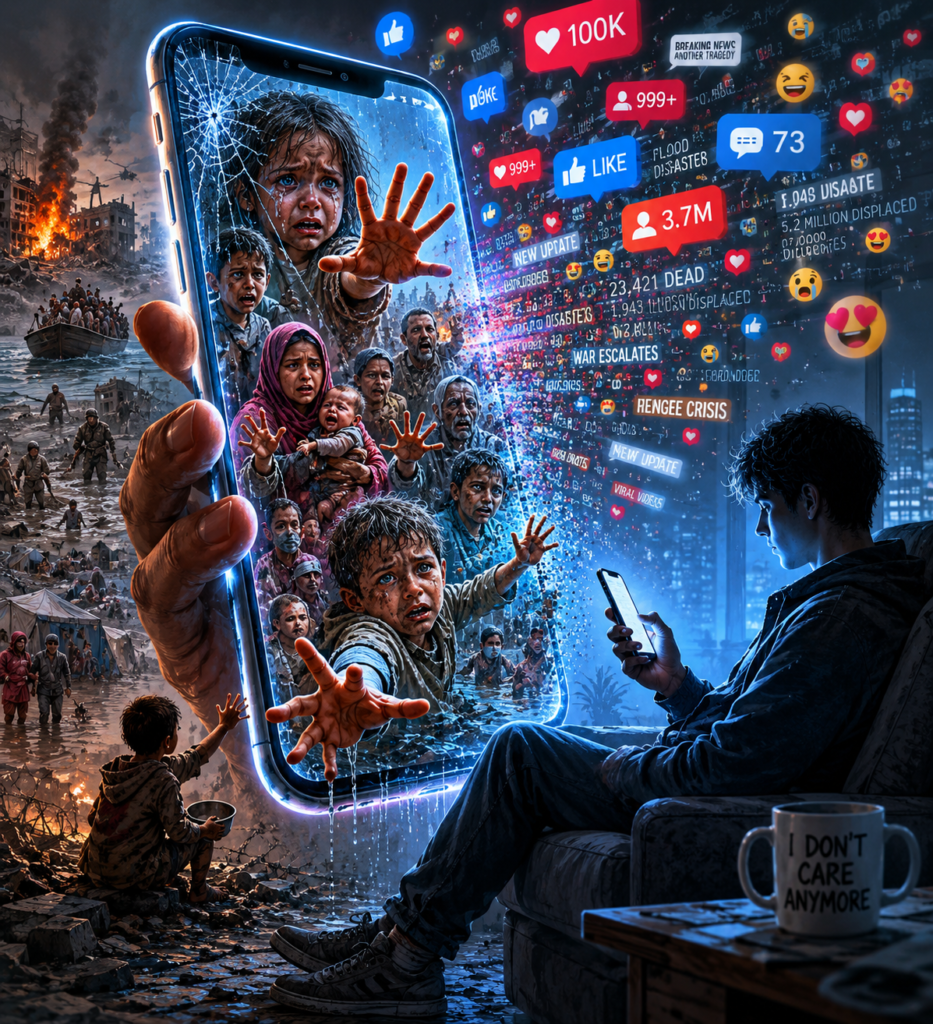
We have this data. We share it. We react with emojis, or, at most, we comment on that post, and then we scroll to the next tragedy.
The reason? Something psychologists call compassion fatigue, and a newer habit called doomscrolling.
This is the paradox of our time. We are the most informed, least moved generation in history.
Previous generations acted on far less information. They marched, donated, and organised because they felt the problem personally. Today, we consume suffering like content. Fast, passive, and forgettable.
But why does information alone fail to move us? The answer may lie in something called psychic numbing, a research by psychologist Paul Slovic showed that most people are caring and will exert great effort to rescue individual victims whose needy plight comes to their attention, yet these same people often become numbly indifferent to the plight of individuals who are “one of many” in a much greater problem. One child trapped in a well moves the world to tears. One million children dying of hunger becomes a statistic. Slovic described this as a potential fundamental deficiency in our humanity (Slovic, P. 2007).
There is also the quiet lie we tell ourselves: that awareness is enough. That sharing an article, signing an online petition, or changing a profile frame constitutes solidarity. It does not. It is the performance of caring without the cost of caring. Researchers have termed this slacktivism, low-effort, symbolic participation that substitutes for, rather than supplements, real action. A 2014 study by Kristofferson, White, and Peloza, published in the Journal of Consumer Research, found that when someone performs a small, public act of token support for a cause, such as wearing a ribbon or joining a Facebook group, they are subsequently less likely to offer more meaningful help, as though the gesture has already discharged their moral obligation.
True solidarity has always demanded something time, money, discomfort, showing up. The digital age has given us a thousand ways to simulate action while remaining perfectly still.
And yet, the problem is not that people are cruel. Most of us are not. The problem is that we have been trained, by systems and habits, to be passive witnesses to a world that desperately needs participants.
History reminds us that change was never made by the most informed people in the room. It was made by those who refused to remain silent. They carried a wound that would not heal, a personal, visceral, impossible-to-scroll-past sense that something was wrong and that they were responsible for fixing it.
That sense of personal responsibility is what we are in danger of losing. When suffering is everywhere, it becomes no one’s problem in particular. When it is no one’s problem, it is everyone’s excuse.
Yet meaningful action does not have to be grand to be powerful. A doctor serving those who cannot afford care, a teacher refusing to overlook a struggling student, a neighbour extending a helping hand, or a journalist risking life and liberty to reveal uncomfortable truths—these are acts of courage. These are not small acts. In a world numbed by distance, they are radical.
The greatest threat facing humanity is no longer the absence of technological capability but the failure to match that capability with moral responsibility. Preventing future catastrophes requires more than political restraint and diplomatic agreements. Politics may shape the boundaries of action, but it cannot alone confront the impulses that reside within the human mind. History has shown how technological achievement, when coupled with humanity’s darker instincts, can leave devastation in its wake. The machinery of destruction has already been built; it is too late to unmake it. What remains within our control is the psychology that guides their use. To understand why the atrocities continue to occur despite unprecedented progress, we must look beyond politics and technology and examine the human mind itself.
The world doesn’t need more successful people. What humanity needs now are more healers, storytellers, and caregivers. PEOPLE WHO REFUSE TO GO NUMB!
Reference
United Nations Department of Economic and Social Affairs. (2025). The Sustainable Development Goals report 2025. United Nations. https://unstats.un.org/sdgs/report/2025/
Slovic, P. (2007). “If I look at the mass I will never act”: Psychic numbing and genocide. Judgment and Decision Making, 2(2), 79–95. DOI: https://doi.org/10.1017/S1930297500000061
Kristofferson, K., White, K., & Peloza, J. (2014). The nature of slacktivism: How the social observability of an initial act of token support affects subsequent prosocial action. Journal of Consumer Research, 40(6), 1149–1166. DOI:10.1086/674137
 Dr. Roshni Mukherjee