

What is the meaning of Procrastination?
In our lives, we all confront such situations where we don’t want to do a particular task then and there, whether it is an important or trivial matter, academic or non-academic (like household chores or other activities), or related to a professional or working field. Like these, delaying tasks till the last minute, or even after their deadlines, despite potential hostile consequences, is referred to as procrastination. Procrastination is sometimes referred to as a “positive hedonic shift” by experts, as it is a self-defeating pattern of behavior characterized by both short-term benefits and long-term consequences. It is not a time management issue, but rather an inability to control emotions. When a task triggers unpleasant emotions like frustration, boredom, self-doubt, or anxiety, our brain searches for an immediate solution to feel better, which can lead to procrastination.
Who are more prone to procrastinate?
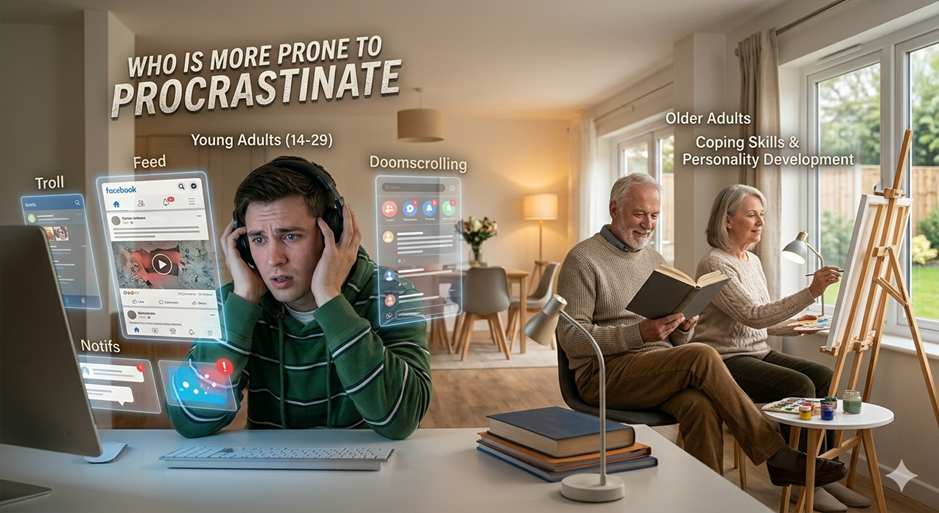
It has been established that children to older people often procrastinate their various tasks at any moment of their lives. According to a research study across several age groups, younger age groups, i.e., 14-to-29-year-olds, are more prone to procrastinate than older age groups (Beutel et al., 2016). This may be due to distractions caused by technology or by the different social media apps used by the younger generation. On the other hand, the older people have much increased coping skills, changes in time perception, and personality development than the younger group.
It is concerning that procrastination affects half of all students, whereas only around 25% of the overall population is affected. Approximately half of the 75% of students who regularly procrastinate believe this behaviour is an ongoing issue (Rozental et al., 2022).
Why do we procrastinate the task ?
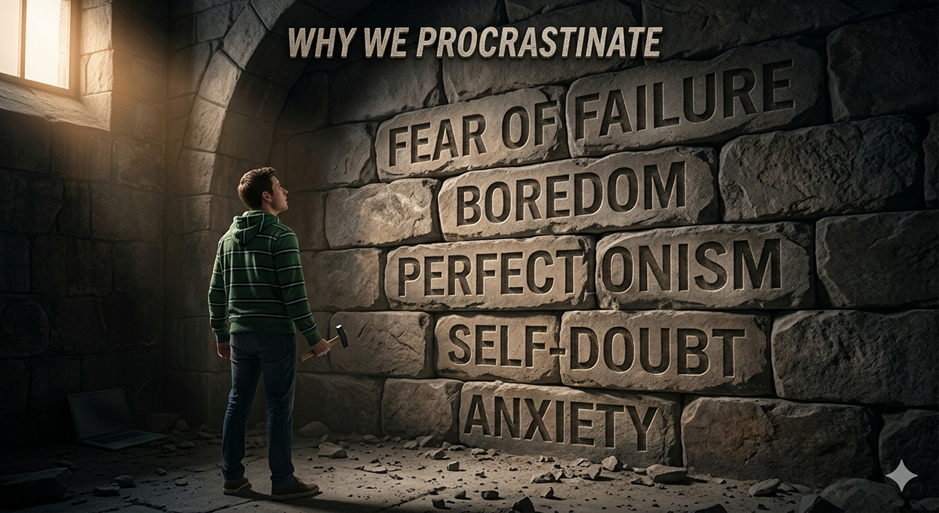
People may procrastinate on tasks because they believe it will make them feel better in the short term, even though procrastinating increases stress over time. For various reasons, we procrastinate:
- Feeling of boredom or discomfort
- Lack of confidence in one’s capabilities
- Fear of making mistakes, fear of failure, or even fear of success
- Perfectionism
- Distraction
How Procrastination Impacts Our Lives ?
Practically everybody has procrastinated at some point. Many people are unaffected by the problem. However, if it is persistent, or one finds himself or herself constantly postponing and then regretting it, he or she may be trapped in a detrimental cycle.
Cohort research involving 3,525 Swedish university students examined the health consequences of procrastination. Higher procrastination scores predicted increasing symptoms of anxiety, depression, and stress. It was also associated with inadequate sleep quality, less physical activity, increased loneliness, and greater financial difficulties (Johansson et al., 2023). In addition, this behavior can have serious consequences, including poor relationships, diminished individual achievement, and reduced capacity to excel at work and school.
How to overcome Procrastination ?
Procrastination is a behaviour that can be effectively controlled and surmounted with the appropriate knowledge, procedures, and support. Here are some ways:
• Create a to-do list: To keep oneself on track, need to try allocating a deadline date to each item.
• Take small steps: To make our activities seem less daunting, divide the items on the list into small, manageable stages.
• Identify the warning signs: Keep an eye out for any thoughts of Procrastination and try the hardest to fight the impulse. If anyone starts to consider putting off their task, make them work on it for a short while.
• Remove distractions: Need to turn off the sources from which the distractions come, like Facebook, Instagram, and WhatsApp.
• Reward time to time: After completing a task from the to-do list, one has to congratulate oneself first and later reward oneself by indulging in something pleasurable.
• Increase Motivation: We often let our emotions and negative thoughts get in the way of accomplishing what we need to do. We tend to avoid tasks that we’ve identified as lacking value.

In Conclusion, almost all of us procrastinate any task for several reasons. The reality is that if we wait until we are in the right state of mind to perform particular tasks (especially difficult or unpleasant ones), we will most likely come to understand that the ideal time never comes, and the task therefore never gets finished. While Procrastination may be impossible to avoid completely, understanding the causes of our tendencies and how to fight them can be beneficial in the future. By incorporating these strategies, it is easier to complete serious, important tasks while managing all other activities.
References
Beutel, M. E., Klein, E. M., Aufenanger, S., Brahler, E., & Dreier, M., et al. (2016). Procrastination, Distress, and Life Satisfaction across the Age Range – A German Representative Community Study. PLOS ONE 11(2). https://doi.org/10.1371/journal.pone.0148054
Johansson, F., Rozental, A., Edlund, K., Cote, P. et al. (2023). Associations Between Procrastination and Subsequent Health Outcomes among University Students in Sweden. JAMA Network Open. 6 (1). https://doi.org/10.1001/jamanetworkopen.2022.49346
Rozental, A., Forsstrom, D., Hussoon, A., & Klingsieck, K. B. (2022). Procrastination among university students: differentiating severe cases in need of support from less severe cases. Front Psychol. 2022;13:783570. https://doi.org/10.3389/fpsyg.2022.783570
Declaration: Images are generated using Generative AI tools
 Dr. Roshni Mukherjee
  Dr. Guriya Sharma