



“Almost everything will work again if you unplug it for a few minutes, including you.” — Anne Lamott
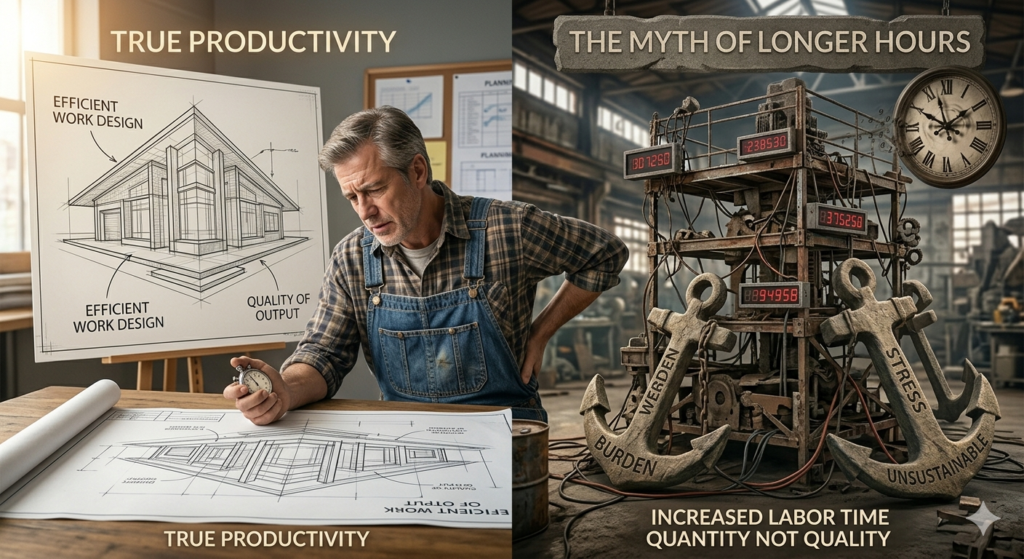
The Myth of Longer Hours and True Productivity
In today’s world, there is an ongoing debate about whether longer work hours lead to higher productivity and contribute to a nation’s growth. Many employees and workers are led to believe that working longer hours equates to increased productivity. But is that scientifically proven? Whether it is a blue-collar job or a white-collar job, productivity is measured by hours of labour. However, does working more mean better work? Let’s explore the idea of productivity. Typically, productivity is gauged by the output of goods or services. Within a particular timeframe, when a person achieves a higher output, they are considered efficient and an asset in the labour ecosystem. Now, the second question is whether higher productivity can mean better work, and where does the quality of output play a role here? The quality of output is often overlooked, and does continuous work and increasing work hours improve productivity? The factors that ensure good productivity are motivation, the person should feel motivated to work enough that it brings a certain sense of joy to the person’s life, and the working environment should not be oppressive. Even if the working hours are above the required threshold, a motivated employee with a good working environment can discharge their duties without compromising their mental health. However, always measuring efficiency with per-day productivity might be detrimental for an aged employee who might be working with underlying health conditions or have multiple household responsibilities that cannot be avoided or transferred to any other.
Often, when freshers join a position, they are expected to come up to maximum efficiency and be new in a job that might require extra hours of work. Those living alone in cities with a low salary package may not afford house help or regular takeaways, as that would drain out their savings, and at such a point, each hour of extra work might become a burden for the employees. These situations would create extreme physical and mental stress for some, and people often compromise their leisure or rest hours.
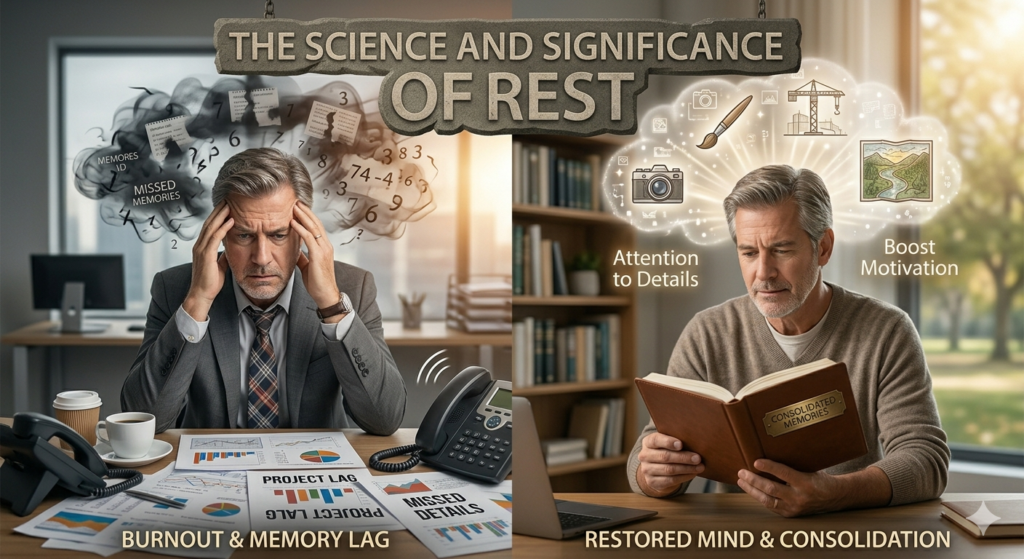
The Science and Significance of Rest
What is rest? And how important is it that we ever think about it? Perhaps not. The importance of rest, detachment, and sleep has always been prioritized in religious scriptures to emphasize their significance for well-being. That shows how even in older days, people knew rest needed to be prioritized. Research has shown that multitasking often causes higher burnout, but taking rest breaks during the day and even occasional breaks from work, along with a regular 7/8 hours of sleep, would help to boost motivation, mental well-being, attention to details and also help improve and consolidate memory (Villar, 2017). Every workplace must design appropriate breaks, but also ensure that the entire time is not spent on social media. A work-life balance is extremely crucial for effective and efficient productivity, and pressuring the employees for increased work hours might temporarily provide a boost in work, but the long-term gains would be bleak. Every person should also learn to find time to promote self-growth through practicing hobbies, going out for vacations, or at least spend time doing tasks other than their job, because even if someone is extremely fond of their job, a rest from work is vital to promote self-growth and better creativity and a better quality of productivity, which would ensure an increase in effective output (Pang, 2016).
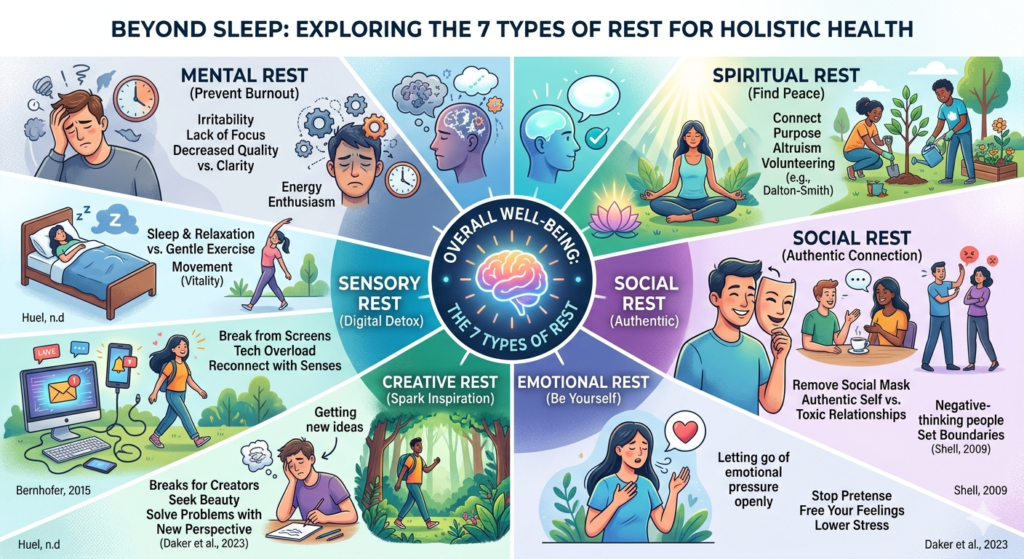
There are overall seven types of rest, namely: mental, spiritual, social, emotional, creative, sensory and physical (Huel, n.d). Out of which we mostly concentrate on the physical aspect of rest, we think that rest means either sitting idle, not engaging in any physical activity or sleeping. Without any argument, sleep is vital, and the current generation often suffers from under-sleep, but the other kinds of rest are absolutely ignored and unaware of by common people (Bernhofer, 2015). But sometimes active rest in the form of creative activity, spiritual activity might benefit a person more than a passive form of rest, that is, either sleep or lying on a couch reading a book. If we discuss each type of rest, then something that should come first is mental rest—the burnout (Stutting, 2023). While we may not lack physical energy, it’s possible to feel irritable and unfocused even after getting enough rest. Our minds can wander frequently, and some individuals may experience fits of anger without recognising that they need mental rest. Failing to achieve this mental relaxation can lead to a lack of enthusiasm, a diminished interest in work, and a decline in work quality (Lewis, 2012). Spiritual rest does not mean always taking religious ways to get peace and calmness. According to Dr Dalton-Smith, meditation and even volunteering in community activities can help to relax spiritually. Altruism is a proven coping mechanism, and many times it has given joy and peace to people. Social and emotional rest are equally needed. We often tend to hide or mask our feelings and pretend in the world, sometimes to like something or behave in a way we do not want to, which creates stress and being authentic relieves us from it. Again, mingling with people with a negative or toxic nature, or even groups whose ideas do not align with you, might be straining. Cutting oneself from both would be helpful always (Shell, 2009). Creative rest is also important, how and why? Creativity does not always mean singing or dancing; it also includes people solving problems through innovations and modifications in the workplace. But again, the typical professions highly associated with creativity, like painters, writers, and music directors, may face fatigue when creating, as there is a forced urge to remain creative, and so breaks are essential (Daker et al., 2023). Sensory rest is mandatory for everyone to take breaks from screens, phones and computers. We are stuck with some digital device all the time without realising that it is affecting our brain health and finally physical rest, which we are almost all aware of.
So, everyone should sleep well, eat well, spend time with family and friends, go for long vacations or even short walks and prioritise rest. Because rest is not procrastination, not sloth, not laziness, but recovery, rejuvenation and restoration of self for better productivity in professional and personal life.
Reference
Pang, A. S. K. (2016). Rest: Why you get more done when you work less. Hachette UK.
Huel. (n.d.). Huel US. https://uk.huel.com/pages/the-seven-types-of-rest
Lewis, G. (2012). Preventing Burnout: Rest, Relaxation, and Reduced Stress.
Stutting, H. L. (2023). The relationship between rest breaks and professional burnout among nurses. Critical Care Nurse, 43(6), 48-56.
Shell, M. J. (2009). The Pain of Pretending.
Daker, R. J., Viskontas, I. V., Porter, G. F., Colaizzi, G. A., Lyons, I. M., & Green, A. E. (2023). Investigating links between creativity anxiety, creative performance, and state-level anxiety and effort during creative thinking. Scientific reports, 13(1), 17095.
Villar, D. (2017, April 21). What you need to know about the negative health effects of long work hours. Australian HR Institute. https://www.ahri.com.au/articles/negative-health-effects-long-work-hours
Declaration: Images are generated using Generative AI tools
 Dr. Chaitali Halder
  Dr. Guriya Sharma