


“Nature is the source of all true knowledge. She has her own logic, her own laws; she has no effect without cause nor invention without necessity.” — Leonardo da Vinci
Animal Behaviour as Early Indicators of Natural Disasters
We no longer have to imagine just how terrifying, horrific, frightening and destructive an earthquake can be; in the recent past, we have been witnessing this with high frequency and each time the question inevitably arises that why is it that earthquakes cannot be predicted in advance, much like weather reports? There is a myth associated with it, that earthquakes cannot be predicted, how then are animals able to sense them in advance? As humans currently lack the ability, it is not likely that there are no systems at all, in reality it is possible. Humans have to find a way to discover it and for that they must have to apply their intellect. Now, if a touch of artificial intelligence (AI) were combined with human biological intelligence, it could be happening like Holmes-Watson!
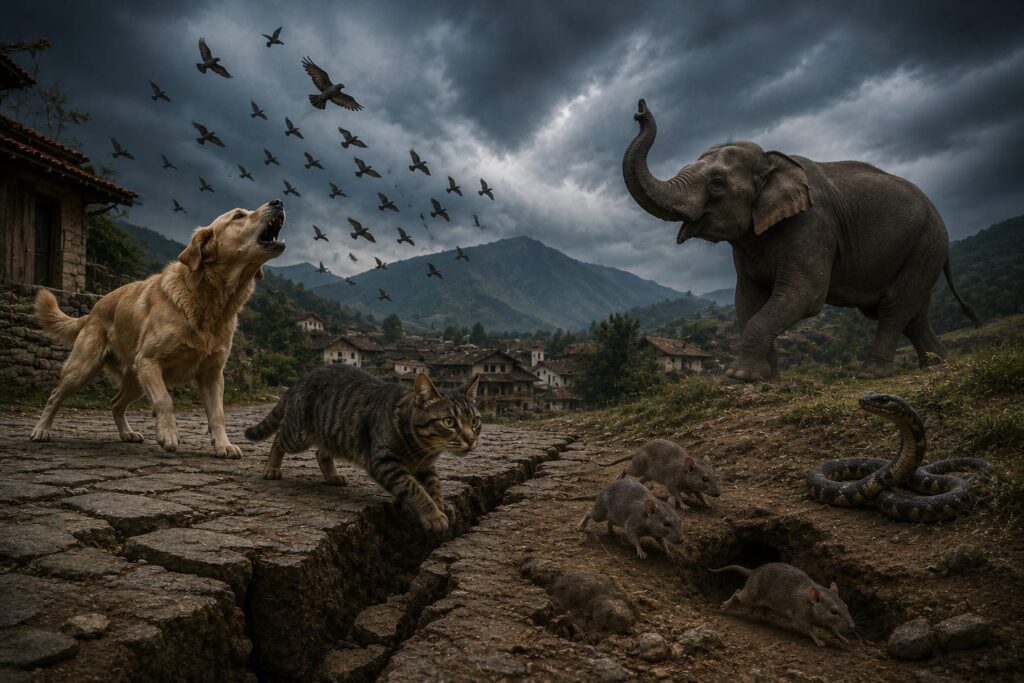
We have always heard and observed that animals can sense all natural disasters in advance and, by altering their behavior accordingly, manage to survive safely. But humans cannot. That is why, during the tsunami, not a single elephant in Thailand, located 1,000 kilometers away from the epicenter perished, whereas people on Thailand’s beaches lost their lives in that disaster (Garstang and Kelley, 2009). In one such study, a specific observation came to light that cows tend to reduce their milk production several days prior to an earthquake. Prompted by this finding, researchers conducted an experimental investigation on this phenomenon and discovered that cows situated near the mock-epicenter of the quake had indeed experienced depletion in milk yielding (Hayakawa and Yamauchi, 2024). Various studies dealt with the animals’ strange behavioral changes or shifts prior to any natural disasters. Some of those mentioned behavior shifts were like, dogs start barking restlessly and refuse shelter, birds abruptly leave roosts or flock erratically and vocalize unusual pitch and time, ants relocate their colonies carrying their eggs and foods, fishes jump and cluster towards surface of the water and move erratically or sometimes become agitated even in the home indoor aquarium, snakes break their hibernation and leave burrows, nocturnal animals shift their hunting time, bees change their foraging pattern and timing, toads leaving their breeding ponds and so on.
The Science Behind Animal Prediction: Sensory Systems, Electromagnetic Precursors and Infrasonic Signals
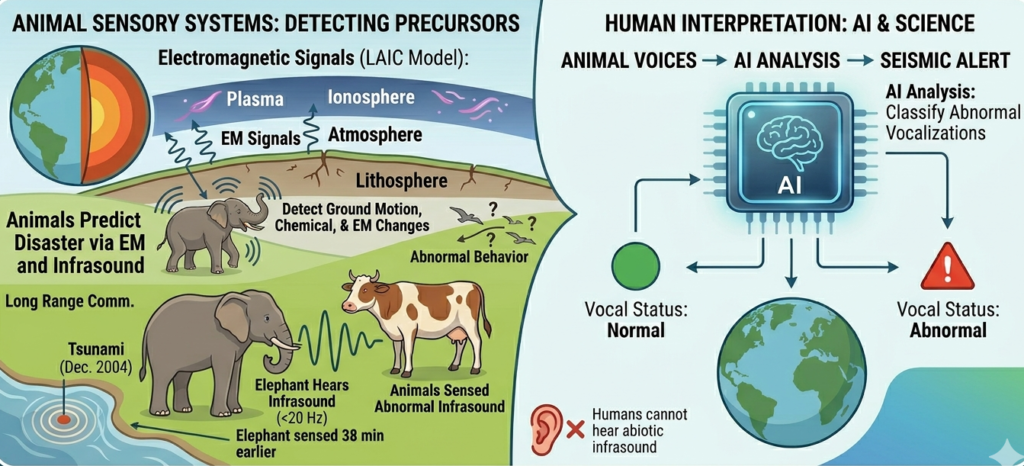
Now the question is, how do animals predict the upcoming disaster, especially earthquakes? Each animal uses different modes of prediction. The animal sensory system does not merely sense the ground motions or chemical or environmental changes but also electromagnetic environmental changes efficiently (Rikitaka, 2001). In most predictions, electromagnetic effect is used which includes radio emissions ranging from ultra-low frequency to high frequency covering very low and low frequency as well (Hayakawa and Yamauchi, 2024). Electromagnetic precursors of Earthquake emerge not only from Lithosphere and Atmosphere but also from Ionosphere. This phenomenon is associated with the Lithosphere -Atmosphere – Ionosphere Coupling (LAIC) model (Pulinets and Ouzounov, 2011). Not only that, research focuses on two more aspects namely seismo-atmospheric and seismo-ionospheric perturbations (Molconov and Hayakawa, 2008 and Hayakawa and Hobara, 2010) associated with earthquake prediction. An important study (Garstang and Kelley, 2017) of this field reveals that, signals what animals can actually detect is a sound signal, generated from a logical and complex geophysical events triggered by precursor earthquake crustal movement (detectable abnormal deformation of earth’s surface before an earthquake).
As we know that many animals use very low or very high frequency sound waves for their communication required to call mating partners, predator- avoidance, predating, navigating etc. Mammals like Bat and Dolphin produce ultra sound (>20000 Hz) for echolocation and Elephant produces infrasound (<20 Hz) for long range communication. A surprising fact must be mentioned here. On December 26, 2004, the day of the tsunami, the earthquake that occurred approximately 160 km off the coast of Sumatra (epicenter) had a magnitude of 9.0 in Richter scale, resulting in waves nearly 50 feet high, hitting Sumatran coast. This wave generated an infrasonic sound of 1 – 10 Hz frequency which travelled through the Atmosphere at 1260km/h, the speed of the sound, to the Tropical Ocean, but Tsunami took the 700 km/h speed to reach there. Elephants were able to effortlessly detect these low-frequency infrasonic sound waves, as this fall within the range of their hearing capabilities and that is precisely why the elephants in Thailand, located less than 1,000 kilometers away from earthquake epicenter, were able to sense the impending disaster 38 minutes before humans realized it (Garstang, 2009).
Abiotic sounds that enable other animals to sense earthquakes and other disasters in advance, humans cannot hear them. Therefore, science is striving to bring these into a system that is comprehensible to humans so that humans can also predict the events at least satisfactorily, not perfectly as other animals.
Bridging the Gap: Artificial Intelligence, Bioacoustics and the Future of Earthquake Prediction
This is precisely where the magic of Artificial Intelligence comes into play. Recent research is attempting to predict earthquakes by using artificial intelligence to identify changes in animal behavior. A researcher (Salakapuri et al., 2026) is saying that they have proposed a novel framework for a model which will predict animal strange behaviors occurring before earthquakes by using Machine Learning (ML) and Deep Learning (DL). The abiotic sounds that serve as earthquake predictors for other animals, to utilize those, Bioacoustics, ML and DL has been used to prepare the proposed framework which will identify the ‘Earthquake Precursor’. Trained using extensive data and samples, this bioacoustics-based system possesses extremely high reliability. Not only that, the system has strong generalization capability and the proposed model could be rated highly for its robustness. Researchers presented that the proposed model uses ML and DL for animals’ voice behaviors.
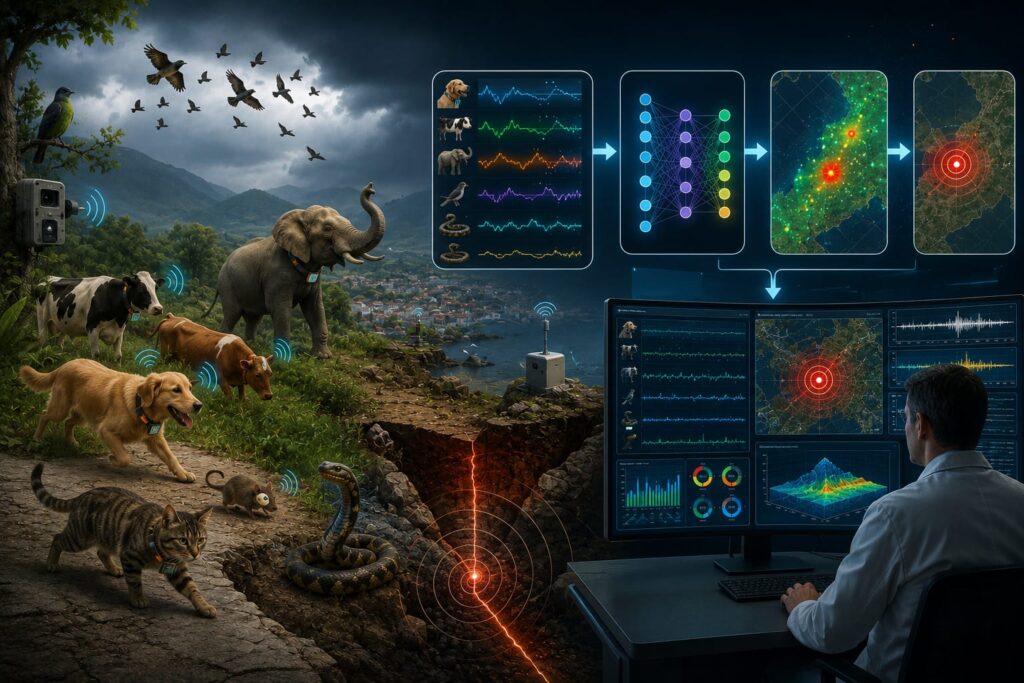
The system will analyze animals’ voice variations. Voices of animals under normal and abnormal conditions were recorded, processed, converted to acoustic features, stored and used to train ML and DL so that the model can distinguish normal and abnormal vocal behaviors of animals. Finally the model will be able to classify unknown animal voices as either normal or abnormal to possible earthquakes. They are claiming that the model will be cost-effective and can be used as a good supplementary system for Earthquake prediction in those areas which lack latest seismic facilities.
Declaration: Images are generated using Generative AI tools